Posts

WOMEN OF TWILIGHT: THE PAINTINGS OF ADELA LEIBOWITZ
Image
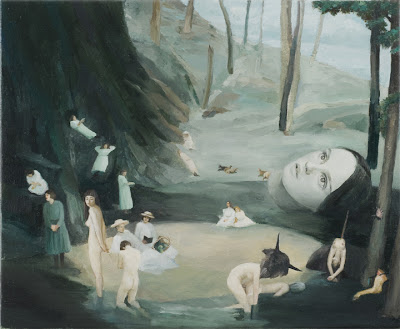
Life is a struggle for meaning. Sometimes we choose the struggle and sometimes the struggle chooses us. In the new exhibition of paintings by Adela Leibowitz, Rites of Passage, we are presented with various mise-en-scene in which a certain existential situation, heavily reliant upon dreams and myths, is provided for our elucidation. Whether they are treatises on the nature of being and existence, or dramas to titillate and mystify, they recommend a set of aesthetic and ontological prejudices, engaging with the vicissitudes of a socially constructed reality while not abandoning more nebulous states of being. Formally, the artist covers new ground, introducing experiments with dimension and scale, working smaller than she ever has before, which allows her to focus upon the actions of her characters as much as the settings and details which surround them. They may become reduced to pale ciphers but their circumstances are no less important. External reality is never what it seems in Leib...
Arthur Cohen at Jack The Pelican Presents

Image
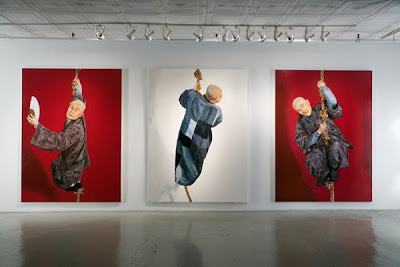
  These new paintings by Arthur Cohen deal with the connection between masculine identity, a visual sublime, and their tangent to the ridiculous. Cohen again portrays himself but also another person, a curiously mime-like Korean Buddhist monk named Sunim. Both he and the monk are involved in an activity which has shamed generations of adolescent boys, and which remains, well into middle-age, a symbol of their weakness: the rope climb. Just the thought of such an endeavor can transform the most confident male into a quivering mass of neurosis. The fact that most of us cannot carry our own weight as human beings, except when held against the ground by gravity and the motor urgency of our own limbs and the other processes (air circulating in lungs, blood flowing in veins) is enough to shame anyone, not only on a personal level, but a transcendental one as well. Force us to leave the surface of the earth of our own volition and a million warning signals immediately flash...

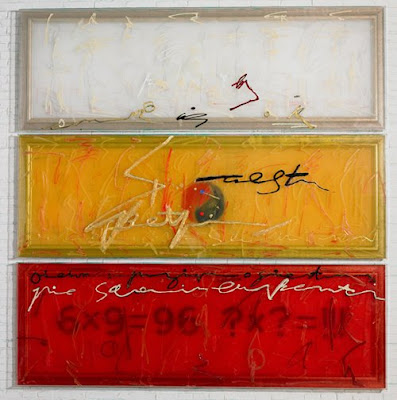
SPEAKING IN GESTURES: THE ART OF CUI XIANJI

Image
All meaning begins with a mark. Whether intentional or accidental, it begins the long path from innocence to wisdom. We make or leave a mark, and then we judge its merit. Soon we add another mark, which is perhaps complementary to the first. Soon we have either a picture, or a language, or both. Whatever it is, it complicates our view of reality. Is it necessary? Absolutely. The artist is at heart a mark-maker, whether by choice or by instinct. Many artists begin their careers as painters, and then graduate to more direct forms made possible with everyday materials and with the accessibility of their implied meaning. This has been the case with Cui Xianji, whose intimate and nostalgic impressions of childhood, a life filled with innate sensation and strong personal emotions, have been transformed into a more rigorous arena for the espousal of formal and conceptual realizations. Both the making of marks and the presentation of installations have their origin in a relationship to a sen...

THE DISCURSIVE ARCHAEOLOGY OF SPACE: THE PHOTOGRAPHY OF LEAH OATES

Image
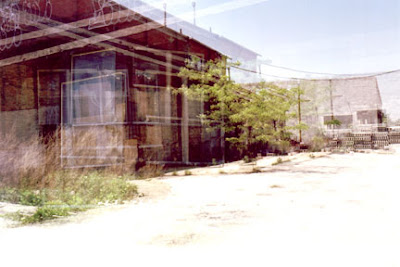
When we look at a photograph, chances are it will remind us of something in our own lives. We have a tendency to personalize whatever we see, to own it with our senses before judgment sweeps in and separates its essential function for us from its palpable uniqueness as an image or its utility as an expression of beauty. Photography created a world in which every thing has an internal referent to its conventional appearance, and via memory or media, to some role that we suspect has a source in intimate experience, whether as metaphor or use value. Yet much of our common experience is branded not by our memory, but by the demands of time. Every object or place has had some role not only in activities related to industry, leisure, or distraction, but once it loses its utility, is once and for all marked by time. It becomes a relic. In our culture, the relic has an especially short half-life. But the photograph reanimates the essential significance of experience itself, creating a form of...

BETWEEN THE LINES: AMANDA CHURCH AT MICHAEL STEINBERG FINE ART

Image
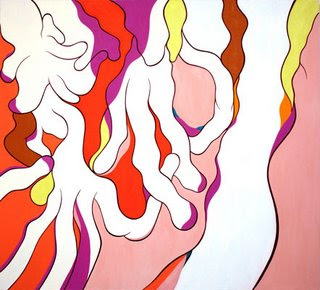
The purpose of imagination is to see. Amanda Church understands that it takes very little to allow us to depart from the real into the imagined, and she provides these elements in her paintings as an entry into the mystery that separates the sensory from what is useful in everyday life. The type of experience they engender can be found easily in nature, like looking for the constellations in the night sky, or divining meaning from tea leaves. Three elements are actively at work in these images: lines, color, and perspective, and each complicates the other two. Looking at “Flash Point” (2006) for instance, we may at first see only areas of color and forms that suggest hands, feet, and the profile of a human face. The shapes inferring human form are not depicted straightforwardly, but as if a picture was taken from so close to its subject that all the details became blurred. Also, Church cuts across the “objective” of the painting with a scrim of other lines that disjoint i...

LIMBO KARMA: THE PAINTINGS OF THOMAS FRONTINI

Image
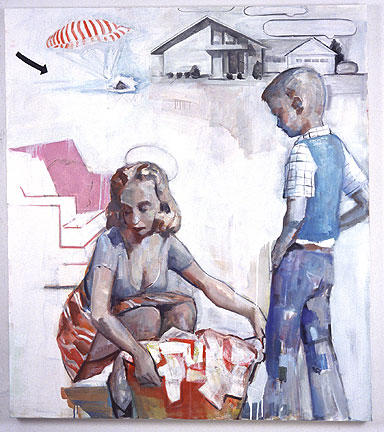
As a painter, Thomas Frontini is a very good spinner of tales. He sees magic in the mundane, and explores the themes of creativity, youthful experience, and the transformative power of the imagination. His characters contain a degree of emotional depth comparable to those in narratives. They arise out of myth and memory, and often enter from his intimate emotional life, and aid him in dramatizing various parables on creativity, family, and the search for identity. They project a quality of innocence that is part fancifulness and part fantasy, affirming Frontini’s earnest appreciation for the rigor of dreams. The structure of fantasy has its base in allegory--the construction of an ethos through divergent modes of expression. A fantasy is more than a single fabrication, but a complication of means in collusion towards the end of setting up an exception to the mundane upon the model of an ethical exception. By creating an atypical progression of the real, the enabler of fantasies is crea...

STUDIO JOURNAL WITH JENNY CARPENTER

Image
  Lately, most of my studio visits are being made in preparation for upcoming group exhibitions, and there are few exceptions. Yet one recent visit was done out of the blue, and it proved quite a surprise. The artist is Jenny Carpenter , originally from Omaha, Nebraska, but who has traveled and lived in various locations around the U.S., and also Australia, Southeast Asia, Europe, and South Africa. These trips are made possible by her work as a freelance art director at various advertising agencies in cities where she has lived. As a New Yorker myself, and thoroughly ensconced in the New York art world, I was very surprised to hear how much the artist traveled. She was able to also take long periods of seclusion in her painting between bouts of travel and work, and New York remained for her a place to dream, not merely one to struggle.   I walked up the six flights of steps in a typical West Village red brick apartment building to be met by her at the threshold...

By Innocence Bound: The Paintings of Mike Cockrill

Image
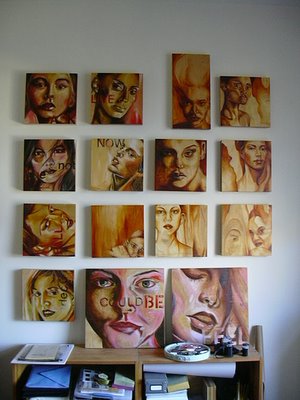
  31 GRAND, Brooklyn, October 15 - November 14, 2004 When we were young, the world seemed completely open to us. It was filled with promise, and we were excited - if uncertain - about what would happen. In many ways, the process of becoming a human being is similar to that of developing an artistic sensibility. We begin as clean slates and slowly, through trial and error, aided by an interiority of uninformed impulses, develop a sensibility which begins to resemble a set of convictions, allowing us to proceed within our purview and ultimately beyond. For these processes to develop, a degree of projection is needed, and art provides just such an outlet. The paintings in Mike Cockrill’s solo exhibition, Then Again, narrate a period of youth during which a variety of anonymous characters – in this case, mainly young girls - experience life in all its wonderful complexity. The entire duration of life is neither available to us through these images, nor does Cockrill consider i...

Sampling Identity: The Work of Carla Gannis

Image
  Identity is the cornerstone of our being and the means by which we impose some small degree of order upon the world, which is always in a state of growth and flux. What we may or may not comprehend is that identity itself is likewise in flux, and though we may often hold to the belief that it represents a fixed quantity, we are hard-pressed to decide which elements define our individual ideas of our selves. In history, when mankind has been in a state of doubt, it has searched for symbols to represent the qualities it most admires or despises. Those first took the form of mythology, then later of religious devotion, and much later—and in some ways finally—the precepts of science. The journey through belief is itself a journey to self-knowledge, and it is through art that man has often found himself seated before not only a fount of valuable learning, but also before a mystery whose purpose has yet to be told. Individual artists throughout history have created oeuvres that pr...

MINING THE URBAN DIVIDE -- The Work of Matthew McCaslin

Image
To be an Installation artist in the 1980s was to be extremely creative in a form generally perceived to be approaching its grandfatherly phase. Born out of concerns related to the urban experience, and added to that the new availability of huge loft “spaces” in the early days of   New York’s SoHo art neighborhood, Installation Art drew attention to a concept of spectacle that borrowed its formal constraint from a sense of objectness. These two elements may seem immediately at odds with one another: the spectacle and the objects, but a spectacle is an event dependent upon the arrangement of given objects, or people. It is perhaps best described as a rearrangement of expectation, and the use of objects or materials in an uncommon manner allows it to be fulfilled more successfully. As people do not conform their everyday activities to the unusual state of affairs that normally creates a spectacle, it is instead formulated among their myriad interactions and the varied uses...