Posts

LIMBO KARMA: THE PAINTINGS OF THOMAS FRONTINI

Image
As a painter, Thomas Frontini is a very good spinner of tales. He sees magic in the mundane, and explores the themes of creativity, youthful experience, and the transformative power of the imagination. His characters contain a degree of emotional depth comparable to those in narratives. They arise out of myth and memory, and often enter from his intimate emotional life, and aid him in dramatizing various parables on creativity, family, and the search for identity. They project a quality of innocence that is part fancifulness and part fantasy, affirming Frontini’s earnest appreciation for the rigor of dreams. The structure of fantasy has its base in allegory--the construction of an ethos through divergent modes of expression. A fantasy is more than a single fabrication, but a complication of means in collusion towards the end of setting up an exception to the mundane upon the model of an ethical exception. By creating an atypical progression of the real, the enabler of fantasies is crea...
STUDIO JOURNAL WITH JENNY CARPENTER

Image
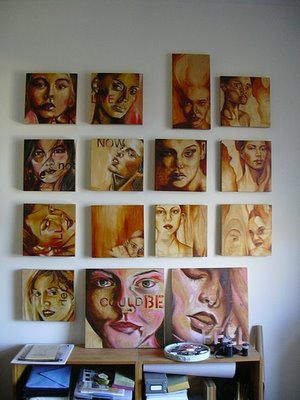
  Lately, most of my studio visits are being made in preparation for upcoming group exhibitions, and there are few exceptions. Yet one recent visit was done out of the blue, and it proved quite a surprise. The artist is Jenny Carpenter , originally from Omaha, Nebraska, but who has traveled and lived in various locations around the U.S., and also Australia, Southeast Asia, Europe, and South Africa. These trips are made possible by her work as a freelance art director at various advertising agencies in cities where she has lived. As a New Yorker myself, and thoroughly ensconced in the New York art world, I was very surprised to hear how much the artist traveled. She was able to also take long periods of seclusion in her painting between bouts of travel and work, and New York remained for her a place to dream, not merely one to struggle.   I walked up the six flights of steps in a typical West Village red brick apartment building to be met by her at the threshold...

By Innocence Bound: The Paintings of Mike Cockrill

Image
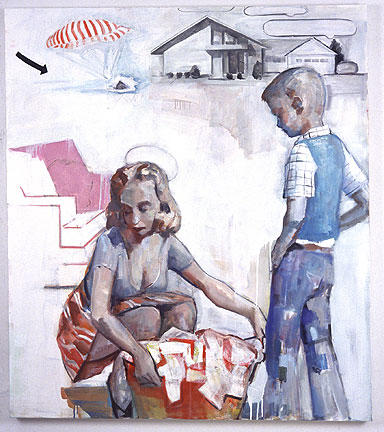
  31 GRAND, Brooklyn, October 15 - November 14, 2004 When we were young, the world seemed completely open to us. It was filled with promise, and we were excited - if uncertain - about what would happen. In many ways, the process of becoming a human being is similar to that of developing an artistic sensibility. We begin as clean slates and slowly, through trial and error, aided by an interiority of uninformed impulses, develop a sensibility which begins to resemble a set of convictions, allowing us to proceed within our purview and ultimately beyond. For these processes to develop, a degree of projection is needed, and art provides just such an outlet. The paintings in Mike Cockrill’s solo exhibition, Then Again, narrate a period of youth during which a variety of anonymous characters – in this case, mainly young girls - experience life in all its wonderful complexity. The entire duration of life is neither available to us through these images, nor does Cockrill consider i...

Sampling Identity: The Work of Carla Gannis

Image
  Identity is the cornerstone of our being and the means by which we impose some small degree of order upon the world, which is always in a state of growth and flux. What we may or may not comprehend is that identity itself is likewise in flux, and though we may often hold to the belief that it represents a fixed quantity, we are hard-pressed to decide which elements define our individual ideas of our selves. In history, when mankind has been in a state of doubt, it has searched for symbols to represent the qualities it most admires or despises. Those first took the form of mythology, then later of religious devotion, and much later—and in some ways finally—the precepts of science. The journey through belief is itself a journey to self-knowledge, and it is through art that man has often found himself seated before not only a fount of valuable learning, but also before a mystery whose purpose has yet to be told. Individual artists throughout history have created oeuvres that pr...

MINING THE URBAN DIVIDE -- The Work of Matthew McCaslin

Image
To be an Installation artist in the 1980s was to be extremely creative in a form generally perceived to be approaching its grandfatherly phase. Born out of concerns related to the urban experience, and added to that the new availability of huge loft “spaces” in the early days of   New York’s SoHo art neighborhood, Installation Art drew attention to a concept of spectacle that borrowed its formal constraint from a sense of objectness. These two elements may seem immediately at odds with one another: the spectacle and the objects, but a spectacle is an event dependent upon the arrangement of given objects, or people. It is perhaps best described as a rearrangement of expectation, and the use of objects or materials in an uncommon manner allows it to be fulfilled more successfully. As people do not conform their everyday activities to the unusual state of affairs that normally creates a spectacle, it is instead formulated among their myriad interactions and the varied uses...

Leemour Pelli: Paintings and Drawings

Image
The aesthetic and formal accomplishments of Leemour Pelli, which are maintained alternately through the activities of painting and drawing, accrue in their degree of portent as they develop her subject matter—an extended treatise on the irreconcilable workings of the heart. Pelli is dedicated to using the human figure as a scale for gauging human drama, and her work springs from an interest in the aesthetic interstices of linguistic and pictorial inspiration. It is at once an investigation of the issues of her own life—which deal mainly with pain, loneliness, and memory; longing, solitude, and desire, and with matters of formal craft. Despite its strong emotional tenor, it should be viewed as an alternating cycle of interpretations. Just as a writer may revise characters from one book to the next, so Pelli reinterprets her characters, the world they live in, and the terms of their thematic reception. Pelli’s work possesses a dynamic emotional charge which, along with her use of the fig...