Posts

A HIDDEN WORLD: THE PAINTINGS OF KATHERINE PARKER

Image
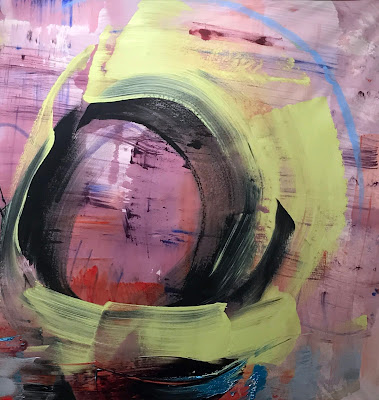
  The challenge of the painter is to invent a version of the world that adds to our own while also amassing a diverse range of expressions that reflects the accumulated knowledge of a particular experience. This is then injected into the process that allows them to invent anew with each canvas, like an equation or solvent that enables all the other elements to seek the most comprehensive solution possible. For Katherine Parker, the spark that begins the alchemy of her transformative paintings, The Ghost Town series, is a tangent where opposing forces meet, commingle, and give birth to an idiosyncratic vision that is fought and won each time, leaving its marks of passage for all to view. The artist begins with an empty canvas but is already filling it up in her mind before a single brush meets the surface. Certain structures or amounts of painterly matter are in the mind, and must be put down initially even if they are due to be obscured. This is the case in each of Parker’s paint...
VIRGINIA KATZ

Image
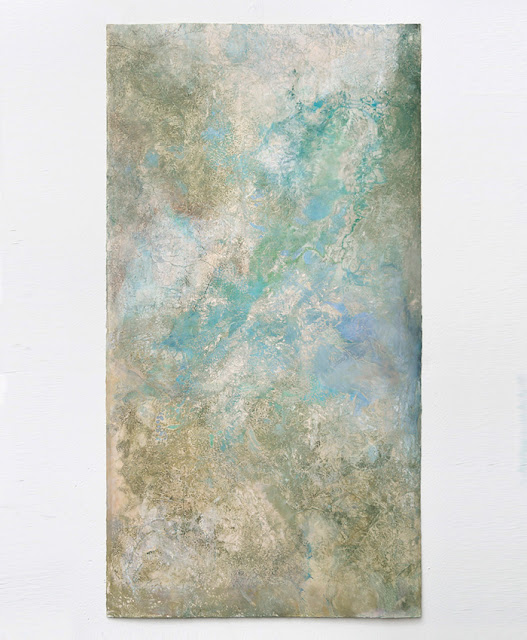
The Artist as Nature   In a famous statement by Jackson Pollock, when asked by Hans Hoffman whether he worked from nature (i.e., from drawings or models), he said “I am nature” and then refused to elaborate. When we consider the work of Virginia Katz in its various guises, this statement may also occur to us. It offers a key to the weight of her accomplishments, which have over time expanded into varying dimensions of an artist not only working from nature, but becoming it. The concept behind Land or Environmental Art creates a decisive break with the narrative conditions within art of the past that depended upon the natural world, such as the Impressionists, or that speculatively utilized spaces for esthetic fodder while imposing conditional restrains, as in Conceptual Art. Katz investigates nature’s vastness and multiplicity as an expressive sublime, and her work alternates among the four elements, and between degrees of perception and projection of scale and depth of meaning....

Francine Tint “Explorations” at The Cavalier Gallery, 3 West 57th Street, New York February 28-March 24, 2018

Image
Art itself is inspired and diverse, it merges and conflates ideas that take the form of creative expression in ways difficult to define. The paintings of Francine Tint are a perfect example of this. At first we may view them as agglomerations of pure pigment, but soon we begin to see portions of her composition stand out from the rest. They take over our concentration. From these elements to the support, our attention teeters back and forth, creating absurdity and doubt.   Titled “Explorations,” her new solo exhibition at The Cavalier Gallery, presents a variety of canvases in which metaphors of motion or growth figure highly. The current paintings of Francine Tint express a variety of truths with a great vigor and deftness of touch. Tint’s paintings take from a broad visual register, and they abound in color and vitality. Nothing here sits idly within its own composition upon the canvas, sleeping in the somnolence of stylistic ease. Hers is the minutiae of a mind on fire, constan...

GHOST FLOWER: THE PAINTINGS OF ELISA JOHNS | Gates of the West

Image
  Elisa Johns’ current body of work presents us with paintings of ‘pretty flowers’—not effusive bunches ornately arranged, but lonely little boughs almost accidentally discovered, that proclaim their idiosyncrasy. She photographs them while on regular hikes amid the peaks and vales of the Sierra Nevada’s, a 70-mile wide by 400-mile long range of mountains crossing the length of the state of California, a vast landscape reminiscent of the early pioneer era in American history. Despite this dramatic backdrop, lush with historical reference, and bounding with breathless vistas, Johns makes little discoveries that she documents photographically and then works out her compositions from the photographs.   Ghost Flowers 2, 2016, Ink and acrylic on paper, 44 x 40 inches   Johns has a penchant for the uncommon growth, although the chances she may have had to encounter these plants in areas where they are most common may have been aided by a bit of homework and an apti...

SUPERNUMARY: THE SCULPTURES OF EMIL ALZAMORA | Gates of the West

Image
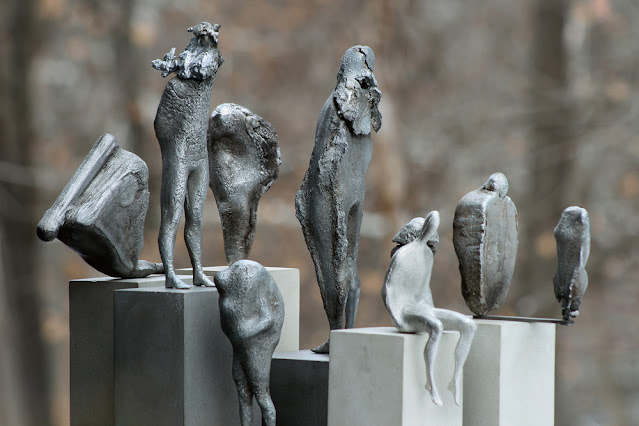
The artist’s attempt to define the ineffable qualities that quantify humanness often result in the construction of effigies closely resembling human appearance. How that artist in question achieves his specific effigy dictates the parameters of his intent. In the case of Emil Alzamora we are presented with two recent series: nearly life size ones with a metallic exterior broken up by striated fissures, like those appearing after an earthquake, titled ‘The Initiates’; and miniature ones that have a molten or melted appearance, under the rubric of ‘Supernumerary.’ Both series play off our reasonable expectation that human forms would naturally take an expressiveness of cerebral repose or narrative energy, yet their fabrication hints at forces far greater than organic life itself—the raging furnace inside planets and stars…the dynamo of creation at work.   THE INITIATES reference an accrual of presences that are unusual in traditional representational sculpture. They att...

ERIC BROWN | Close Quarters

Image
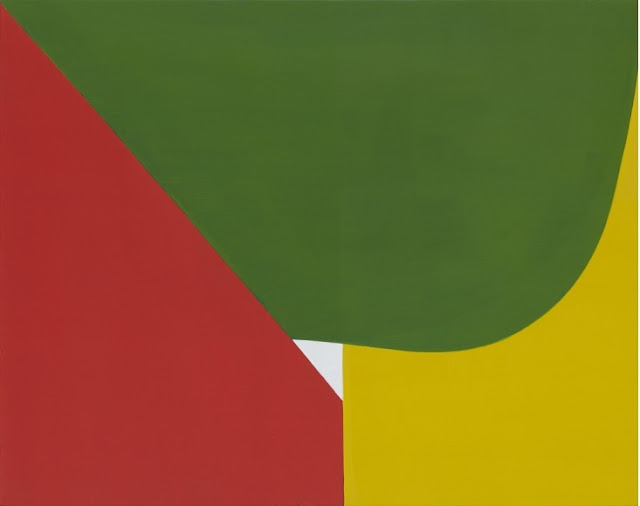
THE WHITE TRIANGLE (2017) Oil on linen, 24 x 30 inches My reaction to certain kinds of art is sometimes, even unknown to me, historically circumscribed. I see a certain kind of painterly construction and my response is an echo of the same response I had ten years or more ago, when I witnessed a similar image in a gallery or museum setting. Perhaps I now bring to it a greater range of echoes, and over time I develop new language to enrich and aggrandize the nature of my experience. The paintings of Eric Brown fall into this category. His recent solo exhibition, Punctuate, on view at Theodore Art in Bushwick, was a quiet revelation. These overly simple works use color and gaps in space to create subtle tensions. His use of titles expands their impact as metaphors for the human experience, which can be dramatized and quantified with so little apparent industry. Take “The White Triangle” for instance (all works 2017). This painting involves the use of three ar...

"Freeform 5" curated by D. Dominick Lombardi at Elga Wimmer PCC, New York, October 7-November 18, 2017

Image
  SANDRA GOTTLIEB Idiosyncrasy is the hallmark of the creative individual, who not only refuses to be limited by critical bias or historical convention, but remains devoted to the idea that drove them in the first place, no matter where it first originated. One can see in the artists of Free Form Five, curated by D. Dominick Lombardi, a dedication to the rigor of their craft. One is easily drawn toward their individual aesthetic world views, which in   a group format, proves a strong impulse constantly evading easy definition. Each of the artists participating in this exhibition has a long established practice of maintaining a level of order that evolves their vision and simultaneously critiques a main convention of art. New histories emerge from their work to qualify and inform future generations. As a photographer who chooses to eschew the human as a subject, Sandra Gottlieb turns instead to nature though not in any decorative or pedestrian fashion. Her relationship to...

STUDIO JOURNAL WITH KEIKO NARAHASHI

Image
I had a studio visit on May 9 th with Keiko Narahashi, whose work was part of my exhibition at The Educational Alliance Gallery in 2004, an exploration of cubes and grids titled SQUARED. I was curious as to what she’d been up to, and contacted her on her web site. It was great to see her and catch up. She had a little bit of everything from her creative history on view, so I was able to consider her growth. There had been a lot of it. I can’t speak to all the growth, but can give you a snapshot of a few of the moves she has made.   Narahashi is still a sculptor, though she has moved through more traditional modes of expression like ceramics, from the painted canvas constructions I saw before. Those were experimental and were a movement away from painting. There is still a strong color element in her work but it operates in concert with a very fragile quality of form, to the degree that it seems most ephemeral. Only in her most recent work is the painterliness returning. ...