Posts

ROB MANGO: A RETROSPECTIVE
Image
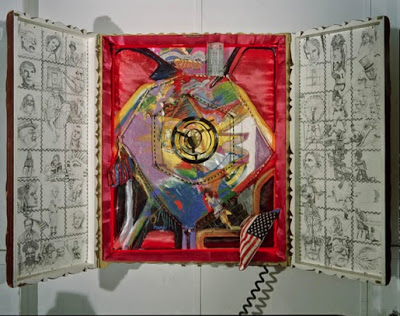
Curated by Robert Curcio ELGA WIMMER GALLERY 526 West 26th Street, New York / November 6-29, 2014 The dozen works which comprise the retrospective of Rob Mango each in their own way represent a watershed event in the artist’s development or life experiences that he unknowingly shared with others. If the artist is the representative idealist for our time, believing in ideas and manifesting expressions that are purer and more primal than the product of any other industry or milieu, then Rob Mango is one of the best versions of such a figure. His work is emboldened by the idealism associated with formalism, its relevant social conscience, and a measure of idiosyncrasy, all without equal. Each of the works on view has a specific story to tell.   The Superman Theory (1984-88), is both a cabinet of curiosities and a hall of heroes. It occurs quite early in Mango’s artistic career, shortly after he first moved to New York, a period when he was momentarily breaking with the realis...

JERRY IN THE BARDO: POEMS BY TSAURAH LITZKY

Image
  There are a few subjects that rarely rise to the surface for discussion. One of these is the condition of extreme age. Writers who reach their older years evade the subject, preferring to deal with it through metaphor, or by use of a story that takes place in the distant past. Few allow that the here and now can contain such difficulty. Tsaurah Litzksy is not one of these. Her new collection of poems, Jerry in the Bardo , deals specifically with the ailing years of her father, Jerry Litzky, who suffered from various ailments that lessened his ability to function as an independent human being, and eventually, to be accepted around others as sane and normal. Her book is suffused with an undying empathy for his struggles as an elderly person. Starting when her father turned eighty, he began to exhibit behavioral changes that set him apart from what she knew of him at an earlier age. The challenge of infirmity for the elderly is only part physical, it is also primarily emotional, as ...

THE ENTROPIC GESTURE: THE PAINTINGS OF ELSIE KAGAN

Image
Elsie Kagan's painting is a form of revelation. It commingles a search for beauty with a sustained effort to manifest how reason, reality, and temperament can aid us in the creation of something new. Mining the history of artistic expression, searching for touchstones and wellsprings of inspiration, and being able to turn that research into a living and breathing new expression that can aptly invigorate the contemporary perception of beauty, is what Kagan does in her work. Kagan's is not only a technical virtuosity but an educated way of painting that refuses to lean on ability alone. It desires a greater statement, one that is filled with the promise of creation and the threat of destruction. There is a primal element in abundance that builds and drives her interest in genres and art movements: a systematic use of energy that creates a dynamic force within each work and throughout her entire oeuvre. Kagan's system is her combined use of historical styles co...

Jason Dodge at Casey Kaplan Gallery

Image
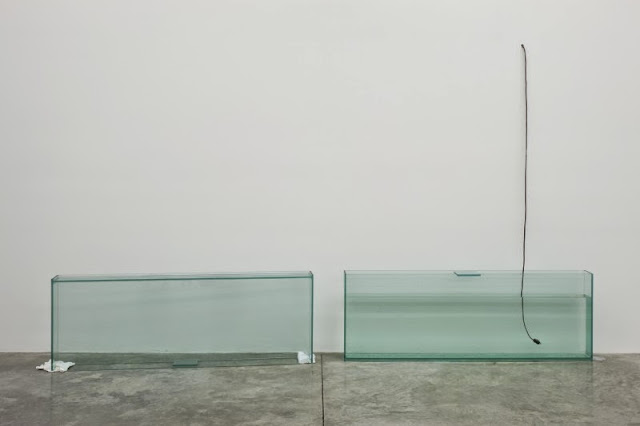
In many ways a gallery is a stage, lacking only a proscenium and seats. In the case of conceptual artist Jason Dodge, there are acts and there are props, and art emerges between them. For his recent exhibition ‘We Are the Meeting’, Dodge presented us with off-stage events, evidence of suspicious acts, and charismatic objects that connected the aesthetic moment of a gallery visit with an event of significant symbolic order. What appears at first to be a random selection of mundane objects with no correlation to one another, or to any system of implied meaning, begins to reveal layers of narrative verging on the dramaturgical. Dodge is not altogether concerned with providing an experience of clear-cut artistic value; his works do not 'look like' art but more like specimens of evidence at a crime scene or an archeological dig; they are models for the advancement of a form of social anthropology.  The first room holds a lightning rod, pointing nor...

David Adamo at Untitled NY

Image
--> Art teaches us about the importance of form, but where does art get its ideas? This is a question that is aptly addressed by the sculpture of David Adamo, whose recent exhibition presented the gallery visitor with a form they might never expect to see in a white cube. Adamo is fascinated by the forms inherent in Nature, and how their implicit realness can not only charm or convince but also obfuscate. Adamo uses sculpture as a form of metaphysical or ontological excavation. He starts with a material and an idea, and with both in hand, he digs at the material or amasses it, shaping and sculpting until forms emerge to fulfill his concept. Nature itself presents a version of the real that clashes with the ideas of art history, displacing them. Adamo's objective this time was to recreate an object that exists only for a specific class of insects; termites who within certain climates are driven to create massive vertical mounds. The mounds are reduced in siz...

Dike Blair at Feature Inc, Frieze Magazine, September 2013

Image
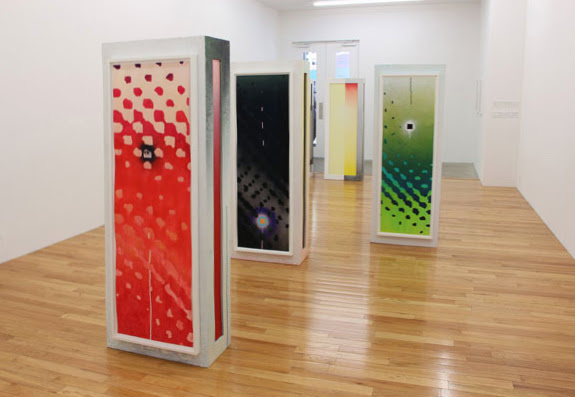
Approaching the art of Dike Blair is no ordinary task. His work is monumental and oblique, sleek and detail oriented, and it maintains its distance from any standard aesthetic response. The works in Blair's recent solo exhibition were two sculptural installations paired with a series of gouache paintings. Hard Shadows (2012) and Dance Dance Dance (2011) are comprised of a pair and a trio of packing crates, which are painted white and then used as both the container and the support structure for a set of abstract gouache paintings on paper. The psychedelic qualities of his paintings alternately reference transcendental mysticism, Modernist architecture, and the suggestively idealistic abstract imagery most commonly associated with iTunes Visualizers, which set whichever music is being played to a randomly generated depiction of imagined cosmological phenomena.      Blair is interested in creating a visual event that transforms into a visceral one. As we look at th...

NATURE DISTILLED: THE PAINTINGS OF PEGGY BATES

Image
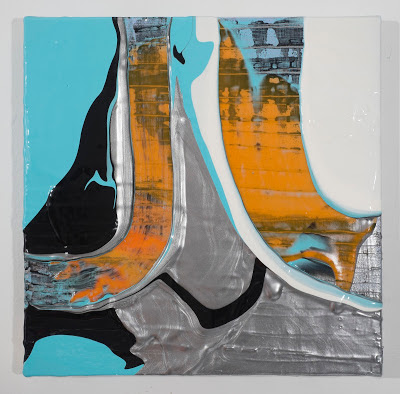
  Peggy Bates is a New York based artist with a history of successful solo exhibitions, participation in international art fairs, grants and awards, works in select corporate  collections, and effusive critical praise and context in nationally recognized media sources such as The New York Times, Art in America, Vanity Fair, and Elle. Bates has been exhibiting in New York since the early 1990's. Her work has been highly exposed by her participation in several art fairs such as Art Miami, Art Wynwood,  AQUA Art Miami, Scope, and the Pool Art Fair. Recently she was selected to participate in "70 Years of Abstract Painting" at the Jason McCoy Gallery. Bates is often referred to as a 'material painter'--someone for whom the paint itself is the primary motif, alternating between formal and symbolic qualities, which are orchestrated through a rigorous practice and a deft understanding of how the elements of color, mass, transparency, and gesture can express both a brea...

COLOR CONTROL: THE PAINTINGS OF DEE SOLIN

Image
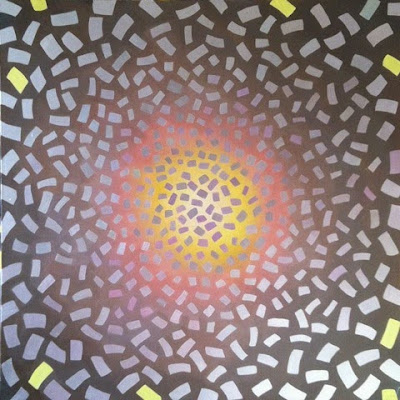
There exist certain elements of painterly description which are so central to the rigor of artifice that they have flowed from one art form into all the rest, even into contemporary technology which allows us a further degree of reflection upon the idiosyncrasies of the natural world such as digital media. Such elements are so essential to the practice of art that we cannot imagine art not having them, nor a world that can be described without them. Most central among these is Color. Just to say the word itself is to speak volumes, while at the same time to be separated from adequate knowledge as needed to explore its capacity for meaning. In the paintings of Dee Solin we encounter an obsessive engagement with color that operates in the stylistic milieu of painters like Julian Stanczak, Carlos Cruz-Diez, Alfred Jensen, and Bridget Riley. Each of these artists attended to color and structure not as naturally opposed aspects of the same experiential, phenomenological univer...

THE LOW ROAD: The Cultural Landscape of the Bowery at The New Museum

Image
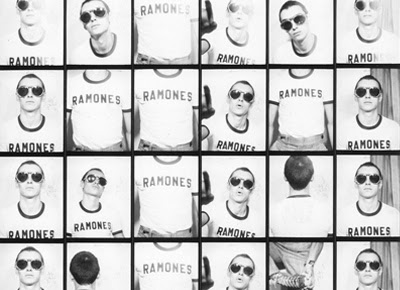
The downtown art scene in New York City has a long and illustrious history that can hardly be contained in any one exhibition. Yet The New Museum’s “Come Closer: Art Around the Bowery 1969–1989” makes it possible to say a great many things. Organized by Ethan Swan, “Come Closer” is about the many individual forms of expression that included the active and sometimes volatile Downtown New York scene of the 70s and 80s. It is also about the individuals who made these statements, about the timbre of their shared existence, and about how we may celebrate of the real and mythical proximity between them.   The exhibition actually emerged out of a more extensive project called the “Bowery Artist Tribute” which so far has comprised three printed publications, a film, and an interactive website from which anyone can travel along the lengths of the Bowery, starting at Canal Street and ending at the corner of 4th Avenue and 10th Street, clicking links along the way to re...