Posts

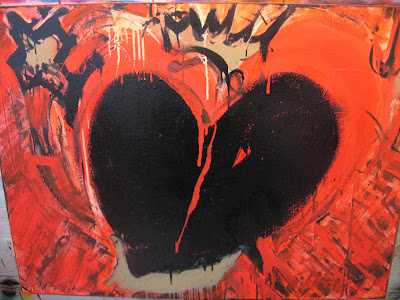
DEVOTION IN MOTION / The Paintings of Marcy Brafman
Image
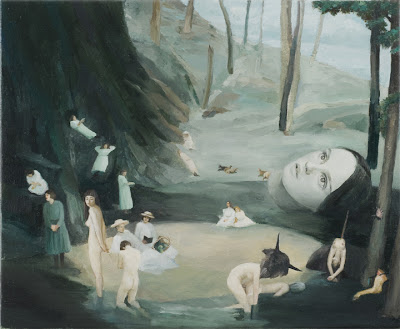
The role of the symbol in art is not only as some semiotic tool, nor is it like a mythical creature, but it is instead, and rather conclusively, an object or scenario emerging out of daily life, something which magnifies (and clarifies) the meaning of everything upon which it touches, even in the most mundane circumstance. In the opening pages of his novel “Immortality,” Milan Kundera speaks of the nature of a gesture: “A gesture cannot be regarded as the expression of an individual, as his creation (because no individual is capable of creating a fully original gesture, belonging to nobody else), nor can it even be regarded as that person's instrument; on the contrary, it is gestures that use us as their instruments, as their bearers and incarnations.” The paintings of Marcy Brafman can be considered empathic gestures. They deal with situations which are inherently symbolic, sometimes taking on the symbol as an icon, and sometimes mining it for its humanistic traits mired in...
D. DOMINICK LOMBARDI: HIDDEN WORLDS

Image
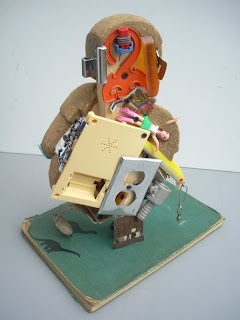
The small but resonant works which comprise D. Dominick Lombardi’s exhibition “Hidden Worlds,” in which both sculpture and drawing/collages depict his eponymous Urchins, define an essential relationship between culture, the power of metaphor, and the notion of innocence. Human behavior links nature to culture, and from this dichotomy emerges further conflicts, such as that between modern and postmodern values. Culture is that tangle of influences which emerges from within us while seeming to approach us from without. Culture, in many ways, defines us, both as an individual pattern of behavior and as a structure of social order. Terry Eagleton, in his book The Idea of Culture (2000) , describes the essential quandary which accompanies any attempt to compare one with the other. Though it is fashionable these days, he states, to see nature as a derivative of culture, culture, etymologically speaking, is a concept derived from nature. We can take this to mean natural nature or human na...

PRESENT TENSE

Image
Available Potential Enterprise / Northampton, MA   We don’t like to think that such differences exist, but artistic expression can be characterized by exceptions in gender. Both women and men have separate but equal agendas, temperaments, and as a consequence of this, their formal and esthetic results may widely differ. This is certainly the case in the exhibition “Present Tense” which brings together the work of Yvonne Estrada, Sean Greene, Clint Jukkala, Barbara Neulinger—four painters who each exemplify a divergent strain in contemporary currents of abstraction. Taken individually, the fusion of four unique talents would be enough reason to warrant attention—even fascination—with the attempts and achievements each makes into the formal ground of painterly abstraction. Yet as gender based pairs, and as practitioners of divergent inspiration, they each add to our understanding of what painting can mean for us. The men in the show are involved with bright colors and hard edges, ...

THE BUSHWICK BIENNIAL, curated by Benjamin Evans, Austin Thomas, Chris Harding, and Jill McDermid

The constant flowering of bohemia is not a construct of advertising, nor of the whims of a dozen infamous gallerists. It is the generational engine of youth culture, alive and well, striving at the border of the mainstream, throwing out its various statements while at the same time contributing to a community that has registered a similar creative echo for at least 25 years. Bushwick is the locus of new creative energies, the same ones that are active in many other parts of Brooklyn, especially its neighboring wards of Williamsburg and Greenpoint.    This year saw the emergence of its first official celebration, The Bushwick Biennial, brainchild of NURTUREart gallery director Benjamin Evans, in collaboration with Austin Thomas of Pocket Utopia, Chris Harding of English Kills, and Jill McDermid of Grace Exhibition Space. I first heard Ben utter these two words over a year ago, and since then he has worked hard to make it a reality. As the director of NURTUREart, he has seen fir...

ANGIE ARLENE SMITH: SHADOWS OF THE HEART

Image
In the tradition of the artist there are many aspects which make up a picture, many procedures and specialties which combine to create that specific illusion of reality called artifice. Yet not every artist is called upon to master them all, not even to become fascinated with a few of them. Some take it upon themselves to discern the qualities which prove the importance of only one specialty. For Angie Arlene Smith that has been landscape, or rather the paradox of perspectival contingencies which we usually regard as the backdrop for dramatic action. Smith is fascinated with the pictorial qualities which construct a scene possessed of mystery, foreboding, and complexity even when there are no persons present. But there are no simple pastoral scenes here, everything is angle and shadow. Sometimes one little element of the picture seems to be coming to life, as if a tree branch or an outcropping of rocks were so vividly drawn they were beginning to move of their own volition. At other t...

TANEY RONIGER AT SLATE GALLERY

Image
There is something very obstinate yet enduring in the work of Taney Roniger. Her recent exhibition “Stones and Ciphers” at Slate Gallery in Brooklyn brings together two bodies of work which share a similar aesthetic interest informed by scientific ideas. They manage a specific aspect of abstraction in which method is equal to madness. How else are we to perceive the finitude which characterizes this work, in which all color is limited to hues of black, white, gray, and sometimes sepia, as if the painting were no more than the printout of some military-industrial computer bank? Roniger doesn’t need words to transmit the values in her paintings. Perhaps because she wants to achieve the status of a document or an artifact--both products of excessive effort and detritus relevant to the passing of time. We look into these images and we see both information and mystery. It makes perfect sense for an artist to be attracted to matters of abstract reality, yet the degree to which Roniger has ex...

Erik Guzman at The Front Room Gallery

Image
    Every artist these days has more than a simple aesthetic, they have their own mythology to promulgate. It’s as if they want to present their art work not only as an example of their creative qualifications, but to manifest elements across the spectrum of their artistic history as individuals. The determination of quality being highly subjective, we are required to engage ourselves with the work on hand to such a degree that its mythos becomes evident.   In the drawings and sculptures of Erik Guzman, we are presented with work which depends upon, and in some cases actually produces, a light source. Think of the light bulb going off in the thought balloon of a cartoon character. Other sources of light are less allegorical but no less mimetic, such as the sun pacing its track across the sky, developing a notion of transience and duration even as it falls prey to the same immutable forces. The sense of alarm, an interruption of daily life to manifest a sense...

WOMEN OF TWILIGHT: THE PAINTINGS OF ADELA LEIBOWITZ

Image
Life is a struggle for meaning. Sometimes we choose the struggle and sometimes the struggle chooses us. In the new exhibition of paintings by Adela Leibowitz, Rites of Passage, we are presented with various mise-en-scene in which a certain existential situation, heavily reliant upon dreams and myths, is provided for our elucidation. Whether they are treatises on the nature of being and existence, or dramas to titillate and mystify, they recommend a set of aesthetic and ontological prejudices, engaging with the vicissitudes of a socially constructed reality while not abandoning more nebulous states of being. Formally, the artist covers new ground, introducing experiments with dimension and scale, working smaller than she ever has before, which allows her to focus upon the actions of her characters as much as the settings and details which surround them. They may become reduced to pale ciphers but their circumstances are no less important. External reality is never what it seems in Leib...

Arthur Cohen at Jack The Pelican Presents

Image
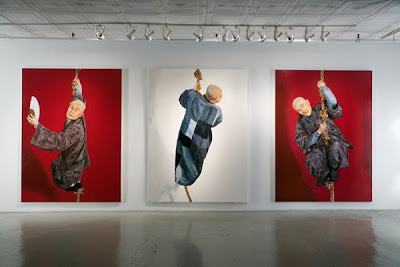
  These new paintings by Arthur Cohen deal with the connection between masculine identity, a visual sublime, and their tangent to the ridiculous. Cohen again portrays himself but also another person, a curiously mime-like Korean Buddhist monk named Sunim. Both he and the monk are involved in an activity which has shamed generations of adolescent boys, and which remains, well into middle-age, a symbol of their weakness: the rope climb. Just the thought of such an endeavor can transform the most confident male into a quivering mass of neurosis. The fact that most of us cannot carry our own weight as human beings, except when held against the ground by gravity and the motor urgency of our own limbs and the other processes (air circulating in lungs, blood flowing in veins) is enough to shame anyone, not only on a personal level, but a transcendental one as well. Force us to leave the surface of the earth of our own volition and a million warning signals immediately flash...

SPEAKING IN GESTURES: THE ART OF CUI XIANJI

Image
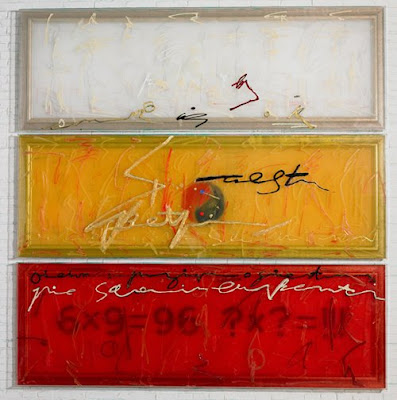
All meaning begins with a mark. Whether intentional or accidental, it begins the long path from innocence to wisdom. We make or leave a mark, and then we judge its merit. Soon we add another mark, which is perhaps complementary to the first. Soon we have either a picture, or a language, or both. Whatever it is, it complicates our view of reality. Is it necessary? Absolutely. The artist is at heart a mark-maker, whether by choice or by instinct. Many artists begin their careers as painters, and then graduate to more direct forms made possible with everyday materials and with the accessibility of their implied meaning. This has been the case with Cui Xianji, whose intimate and nostalgic impressions of childhood, a life filled with innate sensation and strong personal emotions, have been transformed into a more rigorous arena for the espousal of formal and conceptual realizations. Both the making of marks and the presentation of installations have their origin in a relationship to a sen...

THE DISCURSIVE ARCHAEOLOGY OF SPACE: THE PHOTOGRAPHY OF LEAH OATES

Image
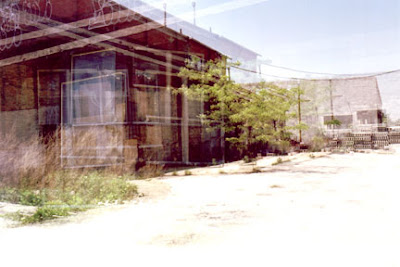
When we look at a photograph, chances are it will remind us of something in our own lives. We have a tendency to personalize whatever we see, to own it with our senses before judgment sweeps in and separates its essential function for us from its palpable uniqueness as an image or its utility as an expression of beauty. Photography created a world in which every thing has an internal referent to its conventional appearance, and via memory or media, to some role that we suspect has a source in intimate experience, whether as metaphor or use value. Yet much of our common experience is branded not by our memory, but by the demands of time. Every object or place has had some role not only in activities related to industry, leisure, or distraction, but once it loses its utility, is once and for all marked by time. It becomes a relic. In our culture, the relic has an especially short half-life. But the photograph reanimates the essential significance of experience itself, creating a form of...