Posts

MINING THE URBAN DIVIDE -- The Work of Matthew McCaslin
Image
To be an Installation artist in the 1980s was to be extremely creative in a form generally perceived to be approaching its grandfatherly phase. Born out of concerns related to the urban experience, and added to that the new availability of huge loft “spaces” in the early days of   New York’s SoHo art neighborhood, Installation Art drew attention to a concept of spectacle that borrowed its formal constraint from a sense of objectness. These two elements may seem immediately at odds with one another: the spectacle and the objects, but a spectacle is an event dependent upon the arrangement of given objects, or people. It is perhaps best described as a rearrangement of expectation, and the use of objects or materials in an uncommon manner allows it to be fulfilled more successfully. As people do not conform their everyday activities to the unusual state of affairs that normally creates a spectacle, it is instead formulated among their myriad interactions and the varied uses...

Leemour Pelli: Paintings and Drawings

Image
The aesthetic and formal accomplishments of Leemour Pelli, which are maintained alternately through the activities of painting and drawing, accrue in their degree of portent as they develop her subject matter—an extended treatise on the irreconcilable workings of the heart. Pelli is dedicated to using the human figure as a scale for gauging human drama, and her work springs from an interest in the aesthetic interstices of linguistic and pictorial inspiration. It is at once an investigation of the issues of her own life—which deal mainly with pain, loneliness, and memory; longing, solitude, and desire, and with matters of formal craft. Despite its strong emotional tenor, it should be viewed as an alternating cycle of interpretations. Just as a writer may revise characters from one book to the next, so Pelli reinterprets her characters, the world they live in, and the terms of their thematic reception. Pelli’s work possesses a dynamic emotional charge which, along with her use of the fig...

Roe Ethridge at Andrew Kreps

Image
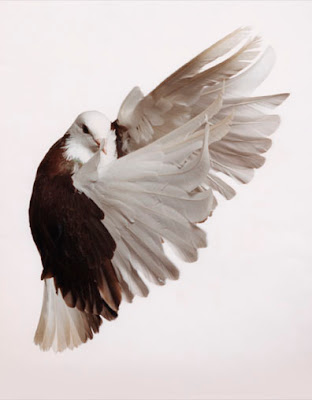
Pigeon (2001), C-print, 38 x 30 inches The relationship between a photograph's overt appearance and the technical ability of the artist is what inspires Roe Ethridge. His second solo exhibition, "The Bow," stresses an interest in nature both as a physical subject and as a process of realistic depiction. Ethridge could be considered a traditional artist, since his images are often either figures or landscapes. Each image is beautiful, yet each image of beauty obscures, or exacts through ironic counterpoint, an unseen context. The most blatantly romantic images, such as those in his "New York Water" series, Osgood Pond and Catskills , present what seem like nature pictorials straight out of Hallmark cards: the haze of late summer covering a large pond seen through a rise of fir trees, and a stream bubbling merrily through a bucolic landscape. Yet hidden in the obvious details are reasons why beauty lies to us, and why we let it. Nature is a backdrop of beautiful...

David Henry Brown at Daniel Silverstein

Image
The idea of celebrity is completely fused with our perspective of everyday reality. Celebrity is a component of fame, a more momentary and satisfying instance in which the illumination of flash bulbs, the “royal treatment” of celebrity peers, and the adoration of unnamed masses all act to separate us from those from whom we bear away a large part of our common nature. As a subject for art, celebrity presents a slippery slope full of hidden agendas, mixed messages, and a breadth of cultural context which is rarely plumbed, for fear it may reveal the collusion between greatness and its opposite. Yet one artist today has made celebrity his main focus. David Henry Brown Jr, over the last few years, has developed an expansive body of work which explores these ideas. The first part of this exploration took the form of a series of actions, subtly interwoven into the social fabric of given public events. Brown invented a company in ‘98 called Carpet Rollers, which for $99 offered to roll out a...

On Kawara: Reading One Million Years (Past and Future) at David Zwirner Gallery

Image
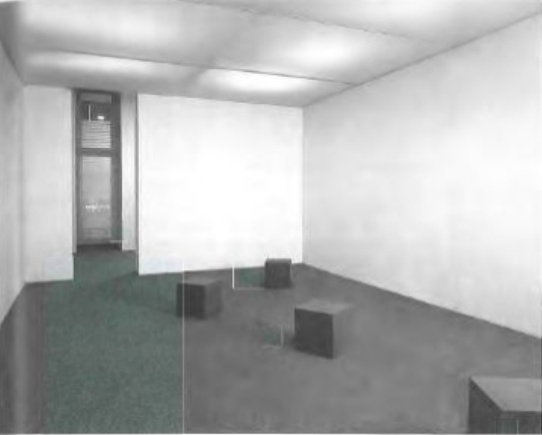
  In his latest exhibition, On Kawara presented what was ostensibly a pair of empty rooms. Minimally designed. they included muted gray carpets and false ceilings similar to those found in corporate offices. The only objects in these rooms were a set of four dark gray foam cubes intended as seats, but used only hesitantly by gallery visitors, who must have assumed they were sculpture. From a sitting position, however, it was easier to absorb the sensory qualities of Kawara's exhibition. Its minimal visuality is meant to underscore a sense of temporal isolation, and to acknowledge as palpable the voices that sound from speakers above the false ceiling. Alternating between a male and a female, one set of voices counts downward from an obscurely large variable (...995,081 BC....995,080 BC....995,079 BC...) and the other counts upward (...3,087 AD....3,088 AD....3,089 AD....). Both counts move forward, one toward the Year Zero, and the other toward future millennia.  Other sensory...

Mona Hatoum at The New Museum

Image
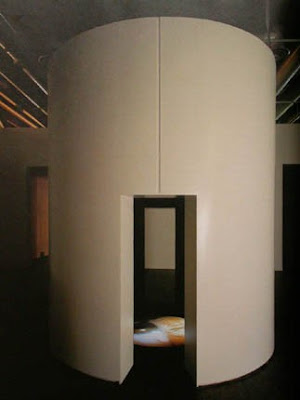
The oeuvre of Mona Hatoum evokes a landscape peopled by absence. On many levels, the ideas of intimacy and vulnerability inhabit her work. She often uses images representing intimacy, such as a bed, to illustrate this. But the messages of her work are not bound to a single object. They take,the form of whatever material her interests follow. In one installation, Hatoum employs a video of the inner orifices of her body. Her works are visual, tactile, and in the words of one critic, corporeal. For what Hatoum's work lacks in an actual human presence is instead represented through metaphoric objects projecting a gestalt of vulnerability and loss, of intimacy and defensiveness or distance, a foreshortening of the desire to either remain intimate, or to iinitiate the process of trust and risk, by which intimacy develops. In Quarters (1996), a set of four five high metal bunk beds face each other in the shape of a cross. I think that this design is only incidental to the space of the in...

Annette Messager "DependanceIndependance" at Gagosian

Image
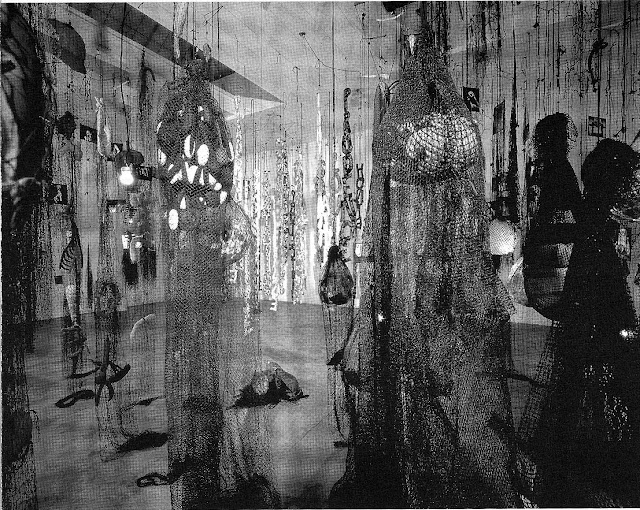
The most recent exhibition by Annette Messager finds her deconstructing her collective oeuvre through an accruance of the motifs that have previously represented her. Dependance lndependance (1995-97) fills the room of Gagosian Gallery, employing both the scale and cavernous feel of the gallery space. Dependancelndependance seems a complete departure from the sophisticated games between language and assemblage evident in many of her previous ereations. Whereas in earlier assemblages such as Penetration (1993 94) or Parade (1994 95) there was a tangible separation between the experience of the viewer and the drama enacted by the installation, here Messager seems to intend the complete confusion of the two. Entering the gallery, the first thing one sees is a mass of coils and nets which hold plastic bags filled with colourful masses resembling human organs or lost objects from the distant past. It is difficult to discern relative wholes within the mixture of images and objects. Howe...

The Maximal Sixties: Pop, Op, and Figuration | The Museum of Modern Art

Image
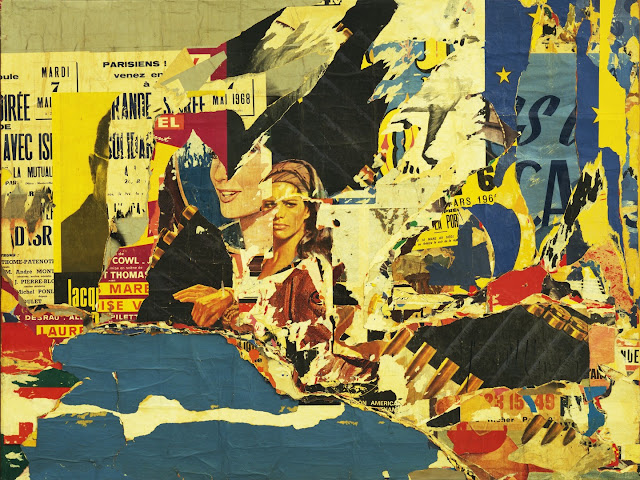
  This small and peculiar exhibition features a mix of works by great and lesser-known artists in three genres, aimed at representing the scenario of adversarial art philosophies in the 1960’s. It functions as a barometer of taste for that era, ranging from the Pop and Op movements to Figuration—all of which, as the show’s curator states, constitute “the flip side of Minimalism’s reductive abstraction and visual austerity.”    The first room contains   Op Art, which is represented by Bridget Riley, Joseph Albers, Lee Bontecou, and Takis. These works possess a strong sense of mediated effect laboriously absent in the other genres. I was drawn to a sculpture by Takis, which functions as a sort of physically realized drawing. Of all the Op artists’ work, Riley’s fades most consistently into a miasma of whiter space, somewhere between the image, our eye, and our mind.   The second room is devoted to Pop Art, and includes minor works by a number...

Roxy Paine at Ronald Feldman Fine Arts

Image
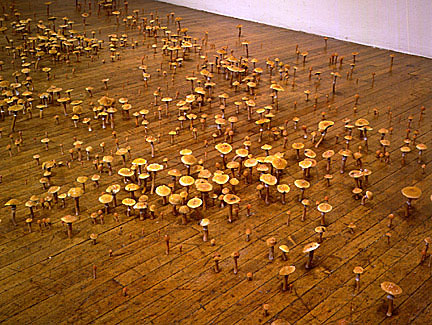
Psilocybe cubensis Field , 1997 (detail) 2200 unique hallucinogenic mushrooms polymer with lacquer and oil paint 4 1/4 x 328 x 5 1/3 inches March 15-April 26, 1997     In April, Ronald Feldman Fine Arts had its second exhibition of sculptures by Roxy Paine, a young artist whose work is some of the most exciting around. It speaks to the artist's role as maker, and to the sort of making, in variety and difference, that is his provenance. Paine's work connects artmaking to the theoretical and logistical methods employed passively by the artist in creating an active art object. Paine insists that his work is about nature and its potential. This recalls Harold Rosenberg's essay "The Anxious Object," which describes how any artwork which is opaque can work off of the viewer's anxiety to suggest ideas. In Paine's case, that idea is a sense of the mode of communication being formed. This language is invented in three ways: by an attempt at the organic simu...