Posts

Mona Hatoum at The New Museum
Image
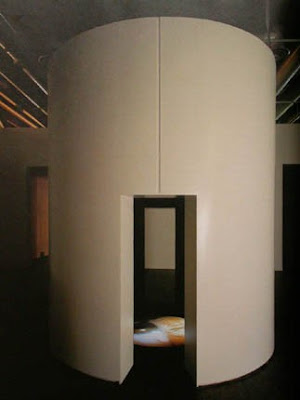
The oeuvre of Mona Hatoum evokes a landscape peopled by absence. On many levels, the ideas of intimacy and vulnerability inhabit her work. She often uses images representing intimacy, such as a bed, to illustrate this. But the messages of her work are not bound to a single object. They take,the form of whatever material her interests follow. In one installation, Hatoum employs a video of the inner orifices of her body. Her works are visual, tactile, and in the words of one critic, corporeal. For what Hatoum's work lacks in an actual human presence is instead represented through metaphoric objects projecting a gestalt of vulnerability and loss, of intimacy and defensiveness or distance, a foreshortening of the desire to either remain intimate, or to iinitiate the process of trust and risk, by which intimacy develops. In Quarters (1996), a set of four five high metal bunk beds face each other in the shape of a cross. I think that this design is only incidental to the space of the in...
Annette Messager "DependanceIndependance" at Gagosian

Image
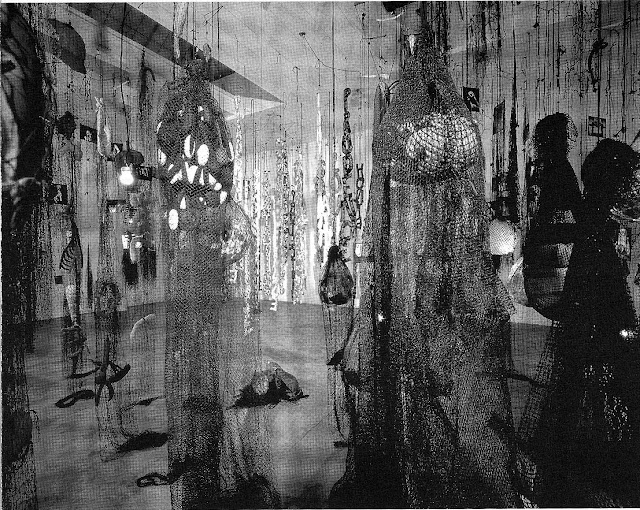
The most recent exhibition by Annette Messager finds her deconstructing her collective oeuvre through an accruance of the motifs that have previously represented her. Dependance lndependance (1995-97) fills the room of Gagosian Gallery, employing both the scale and cavernous feel of the gallery space. Dependancelndependance seems a complete departure from the sophisticated games between language and assemblage evident in many of her previous ereations. Whereas in earlier assemblages such as Penetration (1993 94) or Parade (1994 95) there was a tangible separation between the experience of the viewer and the drama enacted by the installation, here Messager seems to intend the complete confusion of the two. Entering the gallery, the first thing one sees is a mass of coils and nets which hold plastic bags filled with colourful masses resembling human organs or lost objects from the distant past. It is difficult to discern relative wholes within the mixture of images and objects. Howe...

The Maximal Sixties: Pop, Op, and Figuration | The Museum of Modern Art

Image
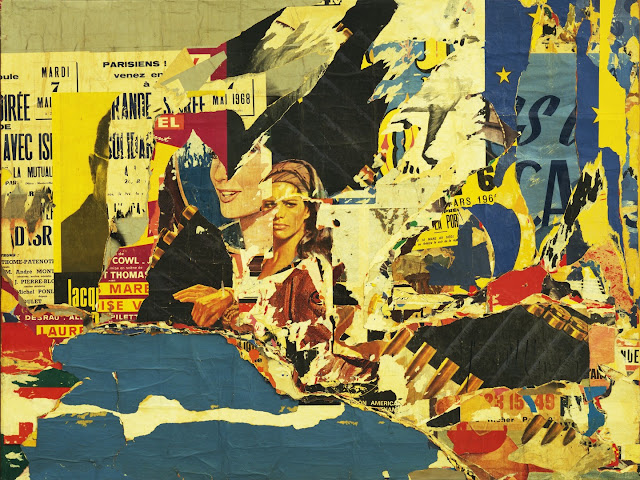
  This small and peculiar exhibition features a mix of works by great and lesser-known artists in three genres, aimed at representing the scenario of adversarial art philosophies in the 1960’s. It functions as a barometer of taste for that era, ranging from the Pop and Op movements to Figuration—all of which, as the show’s curator states, constitute “the flip side of Minimalism’s reductive abstraction and visual austerity.”    The first room contains   Op Art, which is represented by Bridget Riley, Joseph Albers, Lee Bontecou, and Takis. These works possess a strong sense of mediated effect laboriously absent in the other genres. I was drawn to a sculpture by Takis, which functions as a sort of physically realized drawing. Of all the Op artists’ work, Riley’s fades most consistently into a miasma of whiter space, somewhere between the image, our eye, and our mind.   The second room is devoted to Pop Art, and includes minor works by a number...

Roxy Paine at Ronald Feldman Fine Arts

Image
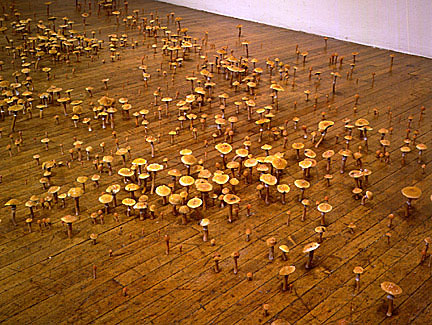
Psilocybe cubensis Field , 1997 (detail) 2200 unique hallucinogenic mushrooms polymer with lacquer and oil paint 4 1/4 x 328 x 5 1/3 inches March 15-April 26, 1997     In April, Ronald Feldman Fine Arts had its second exhibition of sculptures by Roxy Paine, a young artist whose work is some of the most exciting around. It speaks to the artist's role as maker, and to the sort of making, in variety and difference, that is his provenance. Paine's work connects artmaking to the theoretical and logistical methods employed passively by the artist in creating an active art object. Paine insists that his work is about nature and its potential. This recalls Harold Rosenberg's essay "The Anxious Object," which describes how any artwork which is opaque can work off of the viewer's anxiety to suggest ideas. In Paine's case, that idea is a sense of the mode of communication being formed. This language is invented in three ways: by an attempt at the organic simu...

Nancy Spero: Look Back at Gender

Image
RECENT EXHIBITIONS 1996  Sheela Na Gig at Home, Jack Tilton Gallery / Black and The Red III, PPOW / A Cycle in Time, Sacred & Profane II, NY Kunsthalle   Nancy Spero is an artist in whom I’ve had a strong interest of late. Her work is full of drama, poignancy, bitterness, and triumph. Many emotions and politics compete for the viewer’s attention, as do the image she employs in various designs and juxtapositions. It is difficult to face up to the accomplishments of her oeuvre as a whole—it is both comprehensive and indifferent to viewers; it does not cohere as does the work of Jasper Johns or Ellsworth Kelly, or even Louise Bourgeois. This incoherence, though partly intentional, is the primary obstacle to its comprehension. In the main, Spero’s intentions have been nothing if not grandiose: the formulation of a dramatic system pf female representation for the past (women wronged, scorned, justified, and emancipated). Hers is a work of the mind and the heart as much as i...

Petah Coyne at Laurence Miller

Image
The photographs of Petah Coyne explore realms of perception in abstract thought. This is central to modernist theory, which approaches reality in order to revitalize our knowledge of it--and hopefully also reality itself. The particular modernist tendency it resembles is linked to a need to instill order while simultaneously avoiding the traditional expression of order handed down to artists since the Renaissance. This was the case with Marinetti and Braque as it is with Petah Coyne. Primarily known as a sculptor, Coyne has also practiced photography.  There are four distinct groups, each containing a different authorial remove and a degree of abstraction. The first is comprised of "Untitled # 738, 831 & 735". This series is the earliest of Coyne's attempts at photographing the monks , dating from 1992. The monks float while walking, the image of them blurred but still distinct  as a p hotograph of something. T he second ser ies finds her photographing them whil...